
A Place to Call Home
Gillian Lord
In this currently shit world of rising fascism, terrible wars, genocide, corruption and unchecked greed, I’ve been thinking about home.
Home can be many things. If it’s in a country that is safe and fair and compassionate, you’re very lucky.
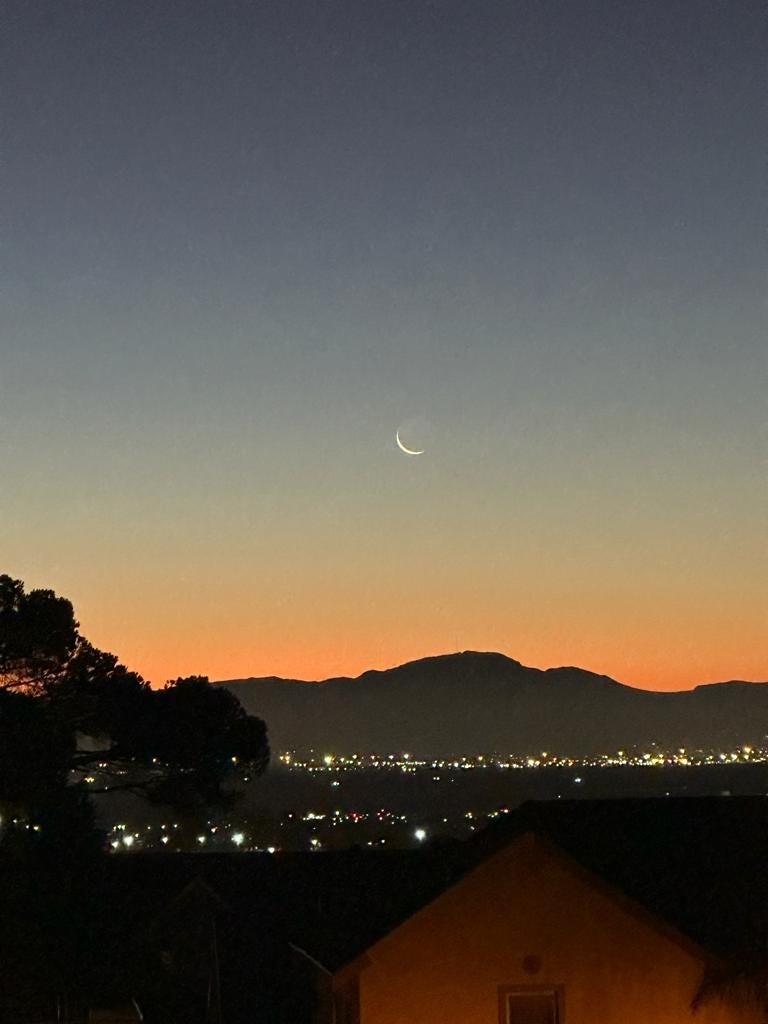
A new moon rises over Cape Town. Picture: Barbara Shepherd.
My own life has undergone seismic shifts. In a year I’ve left my job, become a British citizen, and gone back to the land of my birth.
It’s only the second time I’ve been back to South Africa in 26 years. It absolutely blew my mind in unexpected ways.
Don’t despair, this isn’t a travelogue! But I will say that South Africa remains one of the most beautiful countries in the world, that my old home, Cape Town, remains one of its most beautiful cities. And the food there is absolutely sublime. Trust me, it is.
No comfort zone
It’s the people that got me thinking though, and how home isn’t a comfort zone for them.
Remember, South Africa was a fascist state, living under a draconian Apartheid government. It was a long struggle, and brave and committed people (and not discounting international sanctions) finally ended that regime.
Many who fought for a free and fair democracy paid with their lives.
The first democratic elections were nearly 30 years ago, in April 1994. Millions patiently queued for hours to vote for the first time. Hope was electric. The ANC swept to power.
Fast forward 30 years, and the ANC of yesteryear is not the ANC of today. Nowadays the government is generally shamelessly corrupt and inept. Basic services are collapsing. That’s the simplified version.
Widespread poverty was always an issue in that rich country. This time, though, I was shocked more than ever before.
Power of the people
Instead of the promised investment in housing for all, there are more sprawling ‘informal’ townships where millions live in tin shacks with little or no basic services. People are living on the pavements, it’s abject poverty and very confronting.
But here’s the thing. The resilience of people is astounding. The innovation and creativity, the cheerfulness in the face of all this, is truly remarkable.
Take loadshedding. Pretty much every day in South Africa the power goes out, sometimes for hours. This is partly due to the failure of the unmaintained electricity grid and supply, and partly due to corruption and theft.
You’re driving along a very busy road and the traffic lights just go out. Motorists simply cope, treating big intersections like a four-way stop, for example.
Bigger shopping centres have generators that kick in, smaller ones go dark (but they have LED lights, torches, and other methods so you can keep shopping). Some restaurants have a symbol next to certain dishes, which means they aren’t available during loadshedding.
Needless to say, those who can afford it have solar power, battery storage and inverters. But the vast majority of people just work around it. They live with it.
Incredibly, they just keep smiling.
It’s still a horribly unequal society with little to no government safety nets and a vast gap between rich and poor. It angers me, after all the sacrifices made for a better life for all.
A new community
But it struck me how everyone was united through suffering the same things – corrupt government, lack of civic responsibility (or even humanity) - and how ordinary people just come together to make things work. In the face of a bad government, a new community has grown.
Like bad administrations everywhere, this one ‘others’ people, blames others for the failures that are largely of the government’s own making.
The old apartheid government would blame the ‘communist threat’ and even worse, ‘the swart gevaar’, the black danger. It was a government predicated on racism.
Nowadays, immigrants from further north in Africa get blamed, for ‘taking jobs’ (sound familiar?) ‘white’ capitalists still get blamed (although the ANC has taken to the worst aspects of capitalism with alacrity), fingers are pointed at everything but accountability for a travesty of government.
The ‘othering’
We get that here in the UK too, the ‘othering’ of people, the relentless anti-refugee rhetoric, the anti-immigrant rhetoric, to name just two.
Yet many studies in countries such as the UK and Australia have consistently proven the positive contribution that resettled refugees and new immigrants make to the economy and society.
The myths exist to distract from wider and far more relevant issues and failures that directly affect people’s daily lives.
Add to this a largely ‘captured’ media in the UK, where political propaganda is trotted out relentlessly, instead of the fair, factual journalism we used to know. Now more than ever the responsibility rests on ordinary people to educate themselves, and to know who to trust.
There are excellent independent groups that have sprung up here, the Good Law Project being one, Every Doctor being another, the media outlet, Byline Times, being another. And many individual journalists and campaigners speak truth to power on social media and alternate platforms as the media landscape changes.
It’s never been more important, as the lines between truth, lies and propaganda get ever more blurred and the world feels tinderbox tense.
The law of nature
But, back to Africa. Watching game from an open vehicle in South Africa, within metres of a black rhino, or a huge male lion patrolling his vast territory, or herds of enormous buffalo and elephant, and a grumpy hippo bull snorting a warning from his watery wallow, I was struck by the simple reality of life on the African plains.
They don’t need us, these beautiful creatures. Well, besides needing us to stop killing them. But their lives are entirely theirs, they live and die by the rules of the wild.
In the bigger picture we’re all part of the same eco-system, and we really need to be doing a better job of caring for it.
I’m so proud of Scotland, in the face of all this. For our humanity, our fairness and clear-headedness, for a government that is genuinely committed to a socialist democracy, a government that works for its people.
A true welcome home
My citizenship ceremony, just before I left for South Africa, brought that home profoundly.
In a room in the Dundee City Chambers a group of us gathered, hailing from places like Iran, Pakistan and Africa.
I know how long my journey to this place had taken – eight years, and I was married to a UK citizen. It also cost a lot of money, and it’s not an easy process.
I expected to be told how lucky we were to be accepted. Instead, we were thanked.
We were thanked for the bravery and commitment it takes to leave your home to live in a far away land.
We were thanked for the contribution our respective cultures, cuisine and religions make to Scottish society. We were reminded how much we were valued.
Eventually the trip to my old home, South Africa, came to an end.
On the airport bus back to Dundee from Edinburgh, when Kinnoull Hill Tower struck a silhouette on the horizon and the Carse of Gowrie came into view, I had to fight back tears.
I was home, and I know how lucky I am.
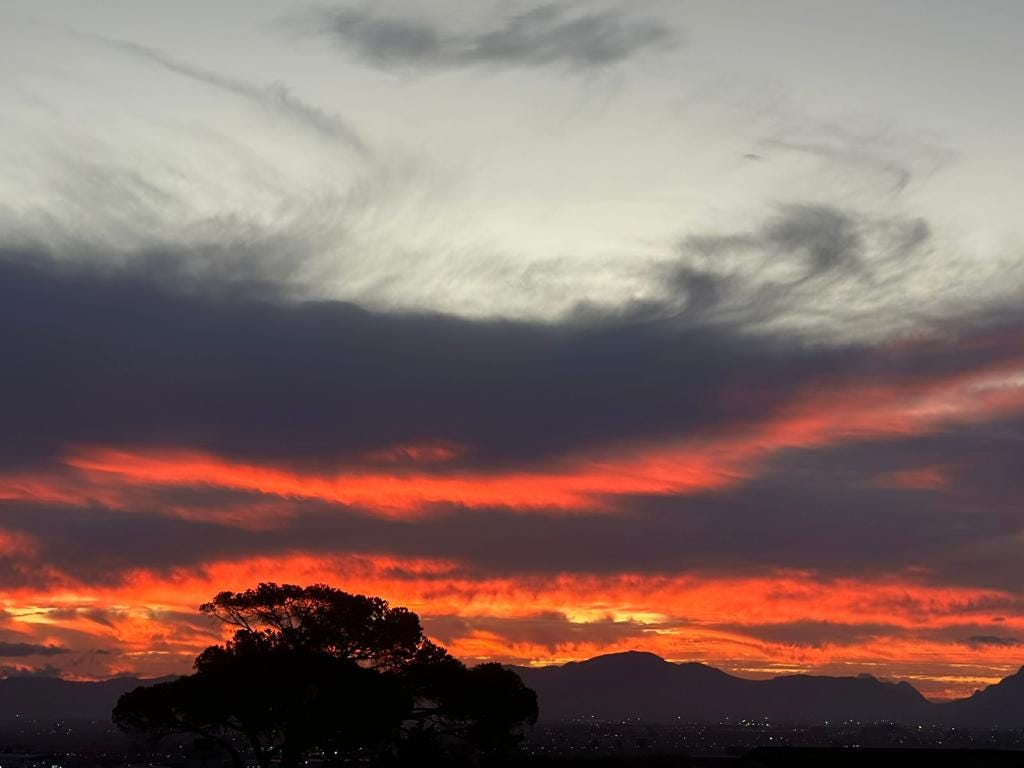
A stunning sunset over Cape Town. Picture: Jenni Watkins.
My family say that I have a heart of stone as I very rarely cry, but at the end of this exquisitely written piece I found my eyes were quite damp. What a rollercoaster of a journey Gillian takes on. Powerful, thought provoking and impeccably articulated.